Bot Architecture
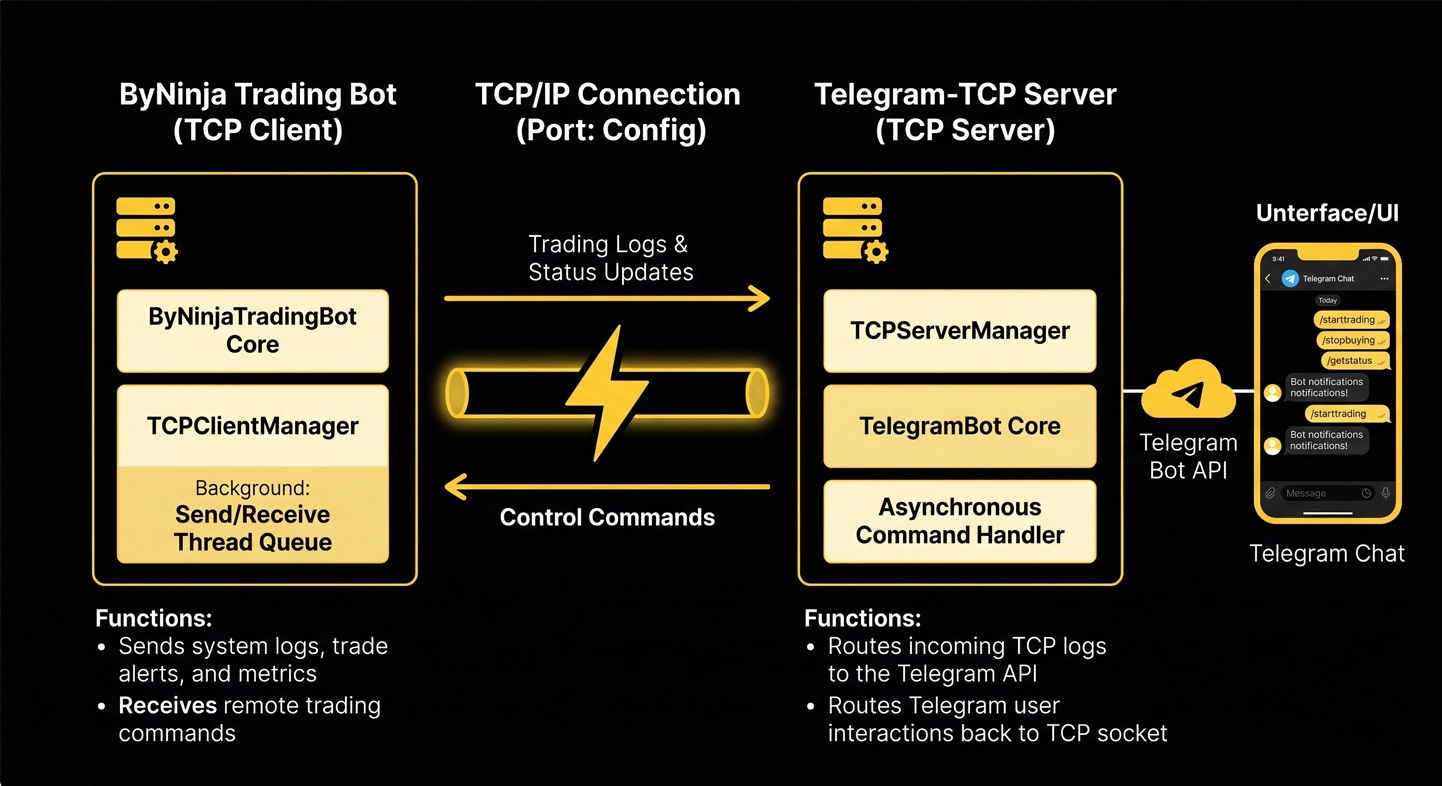
System Overview
The ByNinja Trading platform is built as a distributed multi-process system that separates trading execution from user interaction.
The architecture consists of two independent applications:
- •Trading Bot — responsible for market analysis, strategy execution, risk management, and order processing.
- •Telegram Control Server — responsible for notifications, remote control, and command handling through Telegram.
Both services communicate through a lightweight custom TCP layer, allowing them to run independently while remaining synchronized in real time.
This separation improves stability, scalability, and fault isolation. Even if the Telegram service becomes unavailable, the trading engine can continue operating without interruption.
Process Architecture
The system uses a process-oriented design where each component has a dedicated responsibility.
Trading Process
The trading process manages:
- •Exchange API integration
- •Market monitoring
- •Strategy execution
- •Risk management
- •Position handling
- •Internal logging
The trading engine runs continuously and exposes remote control commands through the TCP client connection.
Telegram Process
The Telegram process handles:
- •Telegram Bot API communication
- •User command processing
- •Notifications and alerts
- •TCP server management
This process acts as a bridge between the user and the trading engine.
Independent Runtime
Both applications are launched separately and operate as independent processes:
python3 -c "from trading.main import main; main()"python3 -c "from telegram.main import main; main()"Because both services are isolated, each process can be restarted, updated, or debugged independently without affecting the other subsystem.
TCP Communication
The communication layer is based on a custom TCP protocol designed for low overhead and real-time interaction.
Communication Flow
Telegram User
      ↓
Telegram Bot
      ↓
TCP Server
      ↓
Trading Bot TCP Client
      ↓
Trading Engine
The reverse flow is used for logs, alerts, and status updates.
Message Structure
All messages are transferred in JSON format with a fixed-length header:
{
    "tag": "command",
    "message": "starttrading",
    "timestamp": 1750000000
}
Supported Features
The TCP layer includes:
- •Automatic reconnection logic
- •Background send/receive workers
- •Thread-safe message queues
- •Graceful shutdown handling
- •Message routing by type
- •Persistent connection monitoring
Command System
The architecture supports remote commands such as:
- •Start / stop trading
- •Enable or disable buying
- •Enable or disable selling
- •Force buy / sell actions
- •Statistics retrieval
- •System status monitoring
Commands can be global or symbol-specific.
Multi-Process Design
The platform follows a multi-process architecture instead of a monolithic design.
Advantages
Isolation
A failure in the Telegram subsystem does not stop trading operations.
Scalability
Each service can be deployed on different machines or containers in the future.
Maintainability
The codebase is separated into logical components with clear responsibilities.
Reliability
TCP reconnection and background workers help maintain stable communication even during temporary network failures.
Concurrent Execution
Trading operations, Telegram polling, TCP communication, and logging all run concurrently using dedicated threads.
Internal Concurrency Model
Inside each process, the system uses multithreading for asynchronous operations.
Trading Application Threads
- •Trading execution thread
- •TCP communication thread
- •Log forwarding thread
- •Background monitoring workers
Telegram Application Threads
- •Telegram polling thread
- •TCP server thread
- •Message forwarding workers
This design ensures that network operations never block the trading engine itself.