Performance
Optimization Techniques
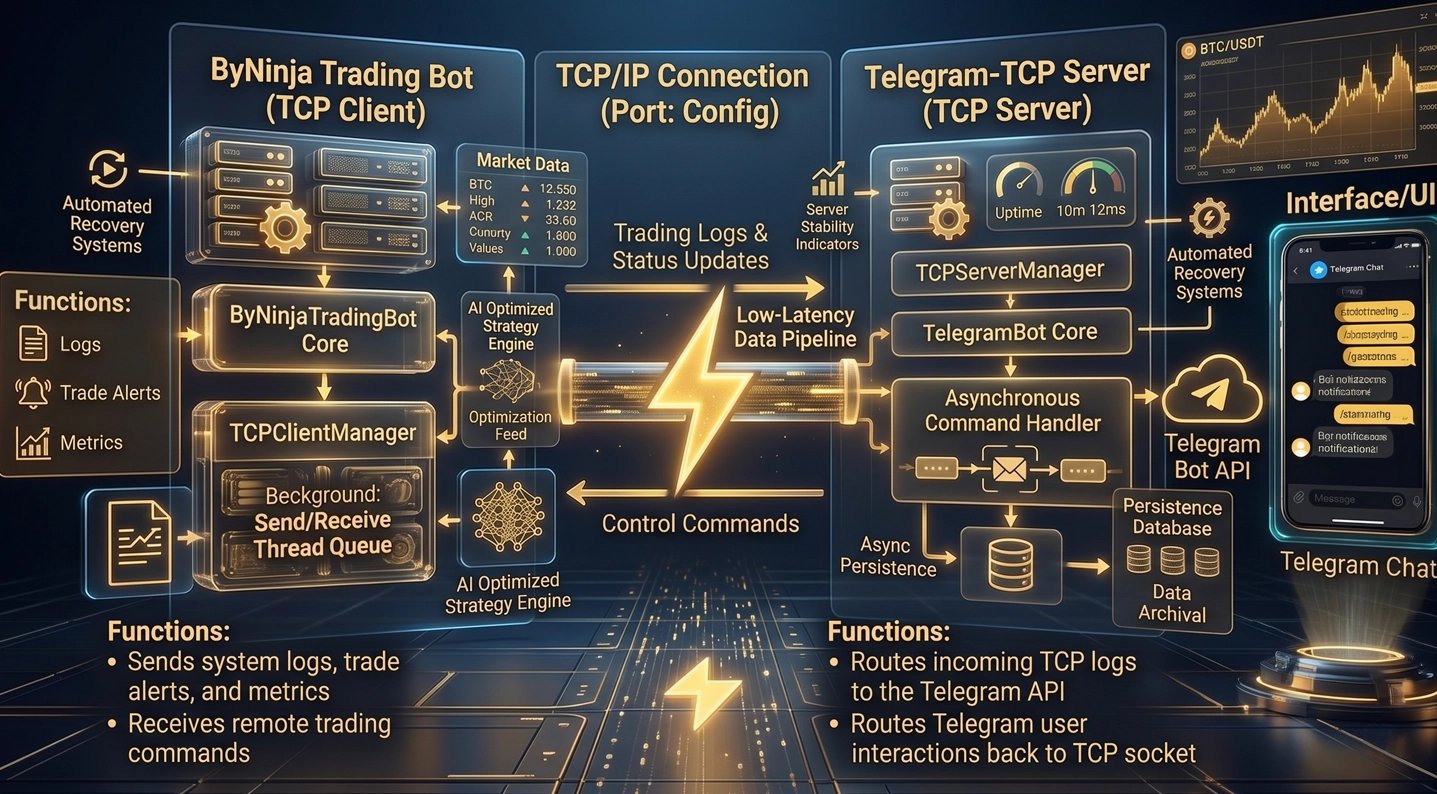
The bot architecture is designed around lightweight execution and minimal blocking operations. Most critical systems work asynchronously or in isolated threads to keep trading logic responsive even under heavy load.
The infrastructure separates responsibilities into dedicated modules:
- •Trading engine
- •TCP communication layer
- •Telegram integration
- •Persistence layer
- •Logging system
- •Background workers
This prevents slow operations from blocking order execution or market analysis.
For example, persistence is handled through an asynchronous queue-based system. State updates are pushed into a background worker instead of writing directly to disk during trading operations. This dramatically reduces execution overhead during active trading.
The logging system is also optimized for production usage:
- •Separate console and file handlers
- •Rotating log files
- •Independent TCP log forwarding
- •Configurable log levels
The bot avoids excessive synchronization points and uses lightweight threading only where necessary. Background workers run as daemon threads, allowing the core strategy loop to remain focused on market execution.
Additional optimization techniques used across the project include:
- •Queue deduplication for persistence saves
- •Atomic file replacement instead of full rewrites
- •Reusable logger instances
- •Persistent TCP connections
- •Explicit module imports with controlled
PYTHONPATH - •Independent restartable services
- •Minimal blocking sleep intervals
The architecture is intentionally modular so users can replace strategy logic without rebuilding the infrastructure layer.
Reducing API Usage
Efficient API usage is critical for any serious trading system.
The platform is designed to reduce unnecessary exchange requests while still maintaining fast reaction speed.
Several infrastructure decisions help minimize API load:
Smart State Persistence
Instead of constantly re-fetching data from the exchange after every restart, the bot stores internal trading state locally using the persistence layer.
This allows:
- •Position recovery
- •Order tracking
- •Strategy continuation after restart
- •Reduced synchronization requests
The bot does not need to rebuild full state from the exchange every time it launches.
Internal Command Routing
The Telegram system communicates through a local TCP layer rather than polling external services for bot state.
Commands like:
- •
starttrading - •
stoptrading - •
buy - •
sell - •
getstatus
are routed internally between modules with almost zero overhead.
This avoids unnecessary external API communication and keeps infrastructure lightweight.
Controlled Logging Levels
Logging verbosity can be configured independently for:
- •Console output
- •File logging
- •General logger level
This prevents excessive debug operations in production environments.
Heavy debug logging can reduce performance significantly in high-frequency systems, so configurable log filtering is important.
Local Recovery Logic
Crash recovery and auto-restart systems help reduce repeated startup synchronization requests.
Instead of rebuilding the entire runtime environment manually after failures, the bot restores quickly using persisted state and watchdog execution loops.
Low Latency Execution
Low latency execution is achieved through infrastructure simplicity and process isolation.
The project avoids unnecessary frameworks and heavy orchestration layers. The trading system runs as direct Python processes with minimal middleware between strategy logic and execution.
Key latency-focused design choices include:
Dedicated Trading Process
The trading bot runs independently from the Telegram interface.
This means:
- •Telegram traffic cannot freeze trading logic
- •Messaging delays do not affect execution
- •External notifications remain isolated
Even if Telegram becomes unavailable, the trading engine continues operating.
Persistent TCP Communication
Communication between modules uses a persistent TCP layer instead of spawning temporary processes or using slow IPC mechanisms.
This provides:
- •Fast command delivery
- •Lightweight message routing
- •Real-time logging streams
- •Minimal overhead communication
Logs from the trading engine are forwarded directly into the Telegram bot through the TCP pipeline, allowing near real-time monitoring without blocking execution.
Background Thread Architecture
Several operations run independently from the core strategy loop:
- •Persistence saves
- •TCP communication
- •Telegram command handling
- •Logging forwarding
- •Recovery workers
This prevents slow I/O operations from interrupting trading execution.
Auto-Restart Infrastructure
The
This minimizes downtime and keeps recovery latency extremely low.
Instead of requiring manual intervention, the infrastructure restores services automatically within seconds.
Minimal Runtime Stack
The system intentionally avoids:
- •Heavy web frameworks
- •Container orchestration overhead
- •Database servers
- •Complex message brokers
- •Large dependency chains
The result is a lightweight execution environment focused entirely on trading performance and operational stability.
The infrastructure acts as a high-speed foundation where users can implement their own trading algorithms while keeping professional-grade persistence, logging, monitoring, restart recovery, and communication systems already fully integrated.