Binance API & Automation
The Complete Beginner Guide to Automating Crypto Trading on Binance
Master Binance API connectivity, understand rate limits, configure secure trading bots, and select high-probability Spot & Futures strategies step-by-step.
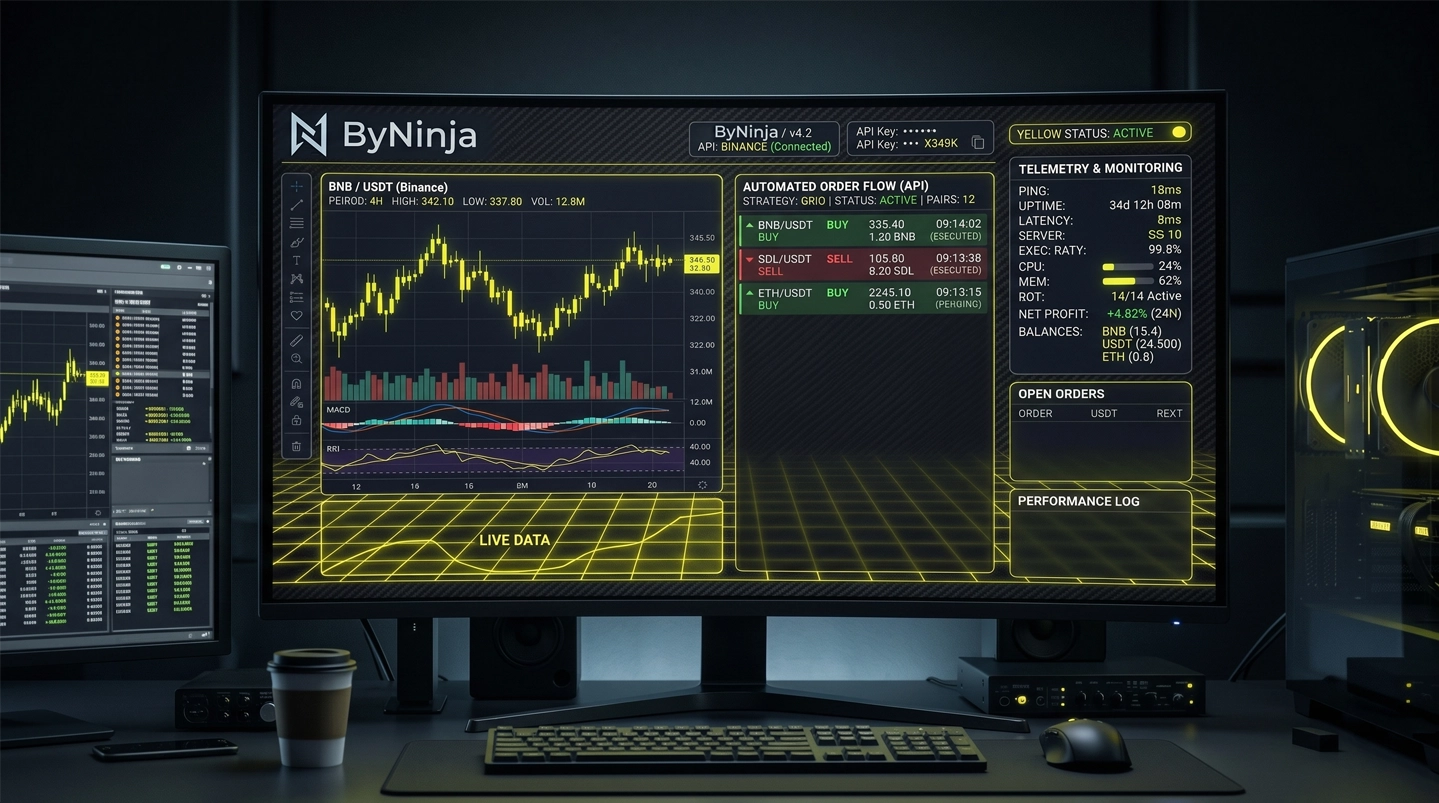
1. Account Configuration & Bot Readiness
Embarking on algorithmic trading requires more than writing a script; it demands a resilient operational foundation. Establishing a secure, reliable bridge between your code and the exchange determines your system's overall speed, uptime, and capital safety. Beginners should start by understanding how API credentials interact with exchange permissions.
Capital sizing is a cornerstone of automated trading. While Binance allows small minimum order amounts (often 5 to 10 USDT equivalent depending on pair lot size filters), a trading bot needs adequate capital buffer to manage multiple concurrent orders or DCA safety steps without triggering margin calls.
When comparing automated bots with manual trading, key trade-offs emerge. Manual trading relies on human intuition and discretionary judgment, but it suffers from emotional fatigue, hesitation, and manual order entry delays. Automated bots execute rules systematically 24/7 without emotional bias, reacting instantly to market triggers.
Choosing between Spot and Futures markets is another vital structural decision. Spot trading bots trade underlying tokens directly with zero liquidation risk, making them suitable for long-term asset accumulation and grid strategies in wide price bands. Futures bots trade derivative contracts with optional leverage, enabling both long and short strategies, but they require strict margin management and stop-loss rules to avoid liquidation during sudden market liquidations.
For novice traders, isolating account funds is critical. Keeping separate sub-accounts or wallets for automated algorithms prevents a software bug from affecting your overall exchange holdings. In the next section, we explore low-latency architecture and API endpoint management.
Binance Unlock Exclusive Rewards
Get up to 20% Trade Rebates and up to a $100 New User bonus.
2. API Connectivity & Bot Architecture
Connecting your script to Binance involves two primary communication channels: REST API endpoints for stateful actions (placing, updating, or cancelling orders) and WebSockets streams for continuous real-time market data (klines, order book ticker ticks, trade feeds) and user account status events.
Before deploying live funds, testing in a risk-free environment is mandatory. Binance provides dedicated Spot and Futures Testnet platforms that replicate real exchange API endpoints using test tokens. Testing on Testnet allows you to verify HMAC signatures, handle edge-case disconnects, and optimize execution timing without risking capital.
Binance Low-Latency Bot System Architecture
Live Market Data Feed
Subscribes to bookTicker, 1s klines, and user data stream (execution reports).
ByNinja Trading Engine
Parses order book levels, evaluates strategy indicators, and tracks active order state.
Signed Order Dispatch
Submits POST requests (LIMIT, MARKET) signed with HMAC SHA256 secret keys.
Code Examples: REST API Signing & WebSockets Connection
Below are two standard Python code examples illustrating how to interface with Binance endpoints using secure HMAC signatures and persistent WebSockets streams.
import time
import hmac
import hashlib
import requests
from urllib.parse import urlencode

# Binance API Credentials (Keep secret! Use environment variables)
API_KEY = "YOUR_BINANCE_API_KEY"
SECRET_KEY = "YOUR_BINANCE_SECRET_KEY"
BASE_URL = "https://testnet.binance.vision" # Use Testnet for safe practice

def send_signed_request(http_method, url_path, payload=None):
    if payload is None:
        payload = {}

    # Append required millisecond timestamp
    payload['timestamp'] = int(time.time() * 1000)
    query_string = urlencode(payload)

    # Generate HMAC SHA256 signature using your secret key
    signature = hmac.new(
        SECRET_KEY.encode('utf-8'),
        query_string.encode('utf-8'),
        hashlib.sha256
    ).hexdigest()

    full_url = f"{BASE_URL}{url_path}?{query_string}&signature={signature}"
    headers = {'X-MBX-APIKEY': API_KEY}

    response = requests.request(http_method, full_url, headers=headers)
    return response.json()

# Example: Check Spot Account Balance
account_info = send_signed_request('GET', '/api/v3/account')
print("Account Permissions & Balances:", account_info.get('balances', [])[:3])import json
import websocket
# Binance WebSocket Live Market Data Telemetry Stream
STREAM_URL = "wss://stream.binance.com:9443/ws/btcusdt@ticker"
def on_message(ws, message):
data = json.loads(message)
symbol = data.get('s')
last_price = data.get('c')
price_change = data.get('p')
print(f"[{symbol}] Live Price: ${last_price} | 24h Change: ${price_change}")
def on_error(ws, error):
print("WebSocket Error Encountered:", error)
def on_close(ws, close_status_code, close_msg):
print("Connection Closed. Reconnecting in 3s...")
def on_open(ws):
print("Successfully Connected to Binance Real-Time Telemetry Stream!")
# Run persistent WebSocket loop
ws = websocket.WebSocketApp(
STREAM_URL,
on_open=on_open,
on_message=on_message,
on_error=on_error,
on_close=on_close
)
ws.run_forever()If you do not want to write a trading framework from scratch, utilizing existing templates or open-source libraries can save months of engineering effort. Our guide on best trading bots for beginners outlines open-source platforms and visual bot creators that integrate seamlessly with Binance API, allowing developers to bypass building complex order matching state machines.
Understanding Binance API rate limits is critical. Binance enforces an IP request weight limit (typically 1200 weight points per minute). Exceeding this limit results in HTTP 429 warnings or temporary IP bans (HTTP 418). Combining persistent WebSockets streams for reading market data with REST requests only for order placement keeps your rate limit usage safely below exchange quotas.
Binance Bot Setup & Rate Limit Calculator
Estimate per-order allocations, API weight usage, and risk boundaries before launching your trading bot.
3. Safety, Security & Risk Mitigation
Security is paramount when working with exchange API keys. Because API keys provide programmatic access to your account balances, an insecure setup exposes funds to unauthorized access. Reviewing key security rules is essential before connecting any external tool.
Enforce strict API key permissions: enable 'Enable Reading' and 'Enable Spot & Margin Trading' or 'Enable Futures', but ALWAYS disable 'Enable Withdrawals'. Furthermore, restrict API key usage to your server's static IP address. Storing API secret keys securely in environment variables rather than plain text code protects against accidental credential leaks.
Risk management logic must be embedded directly into your bot engine. During high volatility events, market spreads widen rapidly. Placing automated stop-loss orders directly on the exchange order book guarantees position exit even if your bot server loses internet connection.
Common beginner pitfalls include hardcoding secret keys into source code, ignoring API error responses (which can lead to order duplication), over-leveraging futures accounts, and omitting exception handlers for network timeouts. Building robust error logging ensures fast resolution when issues arise.
4. Profitability & Strategy Selection
Can automated bots generate consistent profits on Binance? Yes, but success depends on strategy design, realistic yield expectations, fee optimization (using BNB for fee discounts), and discipline. Algorithms excel when trading systematic rules repeatedly without emotional deviation.
Popular bot strategies for passive income include Grid Trading and Dollar-Cost Averaging (DCA). Grid bots place a grid of buy and sell limit orders within a defined price channel, capturing small price oscillations as market price fluctuates back and forth.
DCA bots automate scheduled purchases at set time intervals or price pullbacks, reducing entry price volatility over time. This approach removes market timing pressure and helps construct long-term portfolio positions smoothly.
Sideways or range-bound markets account for nearly 70% of crypto market conditions. Operating grid algorithms during flat consolidation periods captures profits from continuous volatility without relying on strong trending momentum.
5. Frequently Asked Questions
Are trading bots legal and safe to use on Binance?
Yes, automated trading is fully supported and legal on Binance via official API portals. Safety depends on your security setup: disable withdrawal permissions, restrict API keys to your static server IP, and encrypt API secrets.
How can I test my bot strategies without risking real capital?
Binance provides dedicated Spot and Futures Testnet sandboxes. This environment allows you to execute simulated orders, test WebSockets feeds, and verify risk parameters using virtual funds.
What is the minimum capital required to launch a Binance bot?
While minimum order sizes on Binance range from 5 to 10 USDT, running multi-level Grid or DCA strategies requires an initial capital buffer of $50 to $200 to cover multiple safety levels.
Is Spot or Futures trading better for a beginner bot?
Spot trading bots carry zero liquidation risk, making them safer for beginners. Futures bots allow shorting and leverage but require strict stop-loss rules to avoid liquidation.
How do I implement stop-loss boundaries in bot logic?
Program stop-loss triggers directly on Binance as STOP_MARKET or STOP_LIMIT orders. Exchange-level orders ensure execution even if your server loses network connectivity.
Ready to Automate Your Binance Trading?
Connect your Binance account with ByNinja today and start running intelligent, low-latency trading bots 24/7.